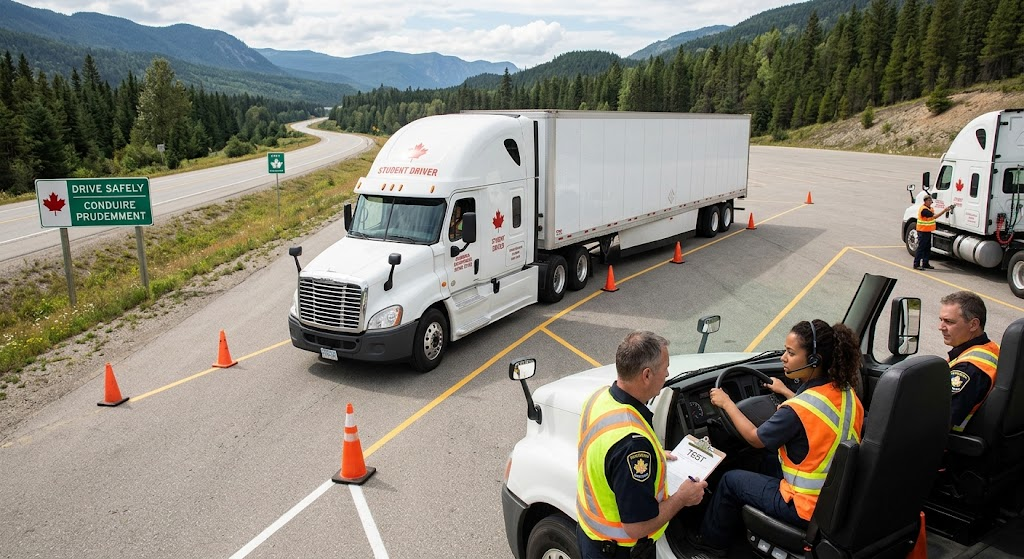
Navigating the commercial driving test in Canada requires comprehensive preparation, a solid understanding of heavy vehicle mechanics, and strict adherence to provincial road rules. Commercial transport forms the backbone of the Canadian economy, keeping supply chains operational from coast to coast. As a result, licensing authorities maintain rigorous standards to evaluate every prospective commercial operator. Obtaining a commercial driver’s licence unlocks rewarding career opportunities across freight, logistics, public transit, and specialized construction sectors.
However, candidates must clear multiple testing stages, including written knowledge exams, pre-trip vehicle inspections, and comprehensive practical road tests. Each Canadian province and territory sets specific classification tiers, ranging from Class 1 heavy tractor-trailers to Class 4 passenger transport vehicles. Understanding these regulatory frameworks ensures drivers approach their official assessments with absolute confidence and thorough technical readiness.
Navigating Written Knowledge Exams and Practice Resources
Before stepping into a heavy vehicle, applicants must prove their theoretical mastery of road safety laws, weight distribution, and hazard management. Preparing effectively requires thorough review of official provincial handbooks, alongside targeted online study tools like the Ontario truck driver licence practice test which helps candidates evaluate their knowledge prior to the real written exam.
Written exams assess critical understanding of air brake systems, vehicle spacing, speed management on steep grades, and winter driving protocols. Passing this initial theoretical assessment earns candidates a commercial instruction permit, granting them legal permission to begin behind-the-wheel training with certified instructors. Diligent study habits during this stage build a strong foundational knowledge that translates directly into safer real-world driving habits on busy highways.
Mastering Mandatory Entry-Level Training Requirements
In recent years, Canada implemented Mandatory Entry-Level Training, commonly known as MELT, across several major provinces to elevate commercial driving standards. This standardized curriculum mandates a set number of classroom theory hours, yard practical exercises, and behind-the-wheel instruction before a candidate can schedule a Class 1 or Class A road test.
Students learn essential operational skills, including coupling and uncoupling semi-trailers, calculating weight limits, executing sharp urban turns, and completing daily logbooks in compliance with hours-of-service regulations. The structured framework ensures all entry-level commercial drivers possess uniform safety skills before navigating complex traffic situations. Investing dedicated effort into completing MELT training dramatically increases a candidate’s likelihood of passing the practical evaluation on their first attempt.
Executing the Pre-Trip Vehicle Inspection Component
A critical section of the practical commercial driving test is the hands-on pre-trip inspection evaluation conducted before driving. Examiners require candidates to inspect key mechanical components systematically, ensuring the vehicle is fully roadworthy and safe to operate under load. Candidates must inspect brake lines, suspension systems, tire tread depths, coupling mechanisms, steering linkages, and exterior lighting setups while verbally explaining what defects they are looking for.
Additionally, vehicles equipped with air brake systems require candidates to demonstrate leak tests, low-pressure warning signal checks, and emergency brake applications. Demonstrating precise mechanical awareness during this phase signals to the examiner that the driver prioritizes preventive maintenance and operational safety above all else.
Demonstrating Advanced Behind-the-Wheel Driving Skills
The practical driving portion evaluates a candidate’s ability to control a heavy commercial vehicle safely in real-world traffic environments. Examiners observe vehicle control, lane positioning, smooth gear shifting, defensive driving habits, and proper mirror usage throughout urban streets, highways, and residential zones. Candidates must execute challenging maneuvers, such as 90-degree alley dock backing, offset parking, and navigating tight intersections without encroaching onto curbs or adjacent lanes.
Maintaining spatial awareness and anticipating potential hazards on busy roads demonstrates professional competence behind the wheel. Passing this rigorous evaluation confirms that a driver is fully capable of operating commercial rigs safely without posing risks to other road users.
Maintaining Commercial Qualifications and Long-Term Career Success
Earning a commercial driver’s licence is just the beginning of a lifelong commitment to road safety and professional development. Commercial drivers in Canada must maintain clean driving records and submit periodic medical evaluation reports to ensure ongoing fitness to operate heavy machinery safely. Staying updated on changing transport regulations, seasonal winter driving techniques, and automated fleet management tools ensures drivers remain competitive in the evolving logistics industry.
Furthermore, adding extra qualifications such as dangerous goods transportation certificates or double-trailer endorsements expands employment opportunities and income potential. Dedicated commercial operators who prioritize safety and continuous learning build rewarding, sustainable careers in Canada’s vital transportation network.
Frequently Asked Questions
What are the main licence classes for commercial driving in Canada?
Commercial licence classifications vary slightly by province, but generally Class 1 (or Class A) covers heavy tractor-trailers, Class 2 (or Class B/E) covers buses, Class 3 (or Class D) covers large straight trucks, and Class 4 (or Class F) covers taxis, ambulances, and small passenger vans.
How long does it take to complete the commercial driving test process?
The timeline varies depending on province-specific requirements, such as Mandatory Entry-Level Training (MELT). Typically, completing classroom theory, practical yard training, behind-the-wheel instruction, and scheduling examinations takes anywhere from 4 to 12 weeks.
Is an air brake endorsement mandatory for all commercial drivers?
An air brake endorsement (often designated as a “Z” or “Q” endorsement depending on the province) is required if the commercial vehicle you intend to operate utilizes a full air brake or air-over-hydraulic system.
What happens if I fail the commercial pre-trip inspection test?
If a candidate fails the pre-trip vehicle inspection portion, the exam cannot proceed to the on-road driving evaluation. You will need to rebook the practical exam, pay the required re-examination fee, and retake the evaluation after the mandatory waiting period.
Are commercial driving licences transferable between Canadian provinces?
Yes, under Canadian interprovincial agreements, fully licensed commercial drivers can exchange their valid licence when relocating to another province, though they may need to satisfy local medical reporting or administrative verification requirements.
Conclusion
Obtaining a commercial driver’s licence in Canada requires dedication, technical mastery, and rigorous practical training. From passing the initial written knowledge exams to mastering pre-trip mechanical inspections and navigating heavy traffic on the road test, each step ensures candidates are fully prepared for the responsibilities of commercial transport.
Completing standardized programs like Mandatory Entry-Level Training builds essential skills that protect drivers and the public alike. By utilizing reliable study resources, practicing vehicle maneuvers thoroughly, and prioritizing defensive driving habits, prospective drivers can successfully earn their credentials and step into rewarding careers across Canada’s thriving transportation and logistics industry.